"I Did Not See an AI Company. I Saw a Telecoms Company."
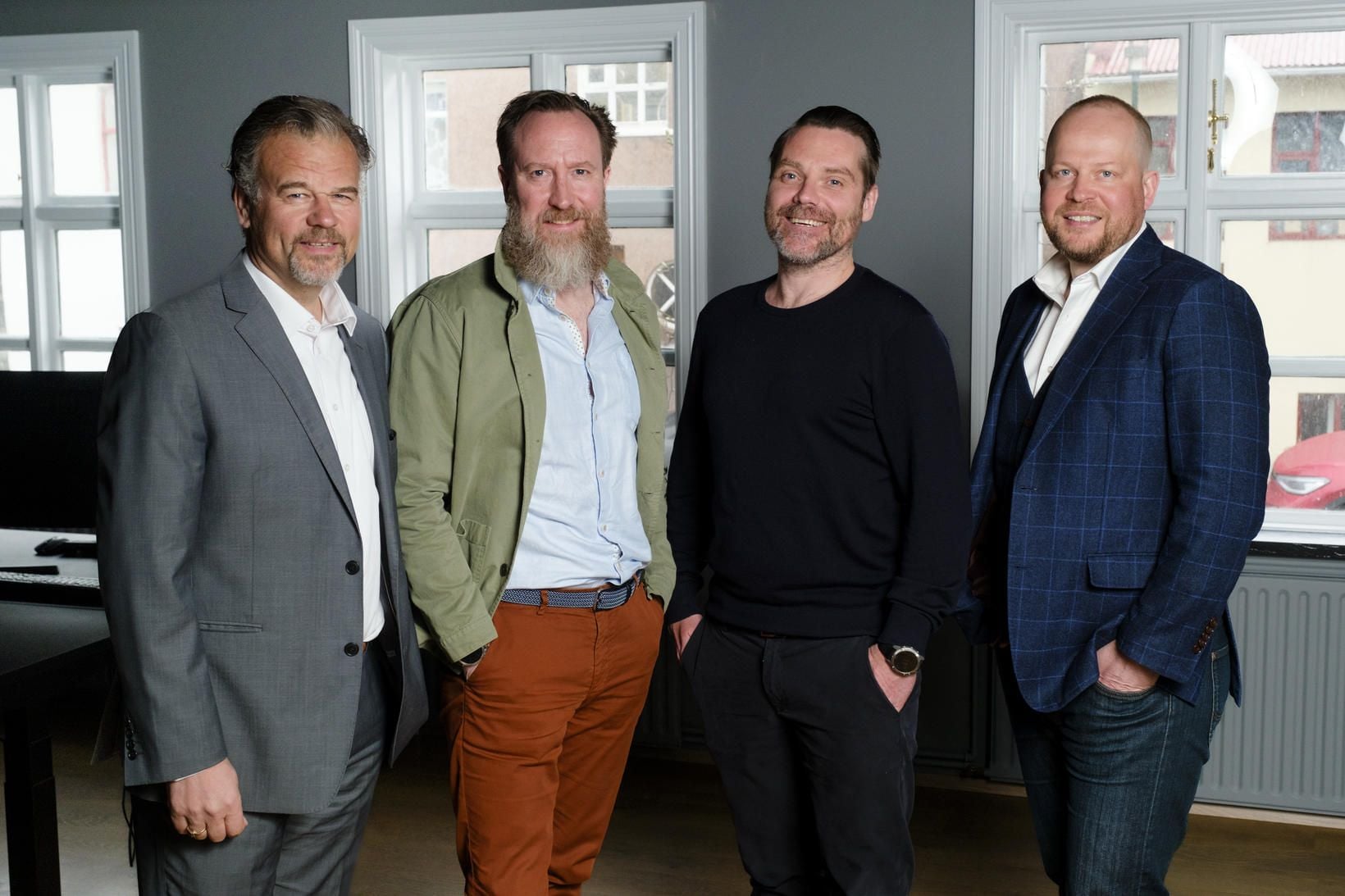
Where Baldur Comes From#
Baldur Stefansson does not come from technology. He comes from deals, structures, and the hard arithmetic of what scales and what does not.
He built the corporate advisory division at Kvika Bank, joining through Beringer Finance Iceland in 2017 and staying when Kvika acquired the operation. Before that, he co-founded Arctica Finance. He advised Icelandair's management through its post-Covid refinancing, one of the most complex restructuring exercises in Icelandic corporate history. The pattern across his career is consistent: find businesses with real assets, real economics, and real structural advantages, and help them scale.
When he left Kvika to found Hamrar Capital Partners alongside his long-time colleagues Sveinn Heidar Gudjonsson and Bjarki Logason, the mandate was clear. Hamrar would be a specialised investment and advisory firm. Not a fund that writes cheques into slide decks. A firm that builds businesses alongside management teams.
"Hamrar exists because we kept seeing the same gap," Baldur says. "Businesses with genuine structural advantages (real assets, real unit economics, real compounding dynamics) that were being evaluated by investors who only understood software multiples. The language of the market had moved so far toward 'recurring revenue' and 'platform' that people had stopped asking the harder question: does this business actually get better with every unit deployed?"
OZ was exactly that kind of business.
Why OZ Was Not a Typical Investment#
Most AI companies in 2023 had the same pitch: large model, cloud compute, API access, land-and-expand. Baldur had seen hundreds of these decks. He was not interested.
"I am not an AI sceptic," he says. "I am a unit economics sceptic. Most AI companies I evaluated had a cost structure that scaled linearly with revenue. More customers, more compute, more annotation labour, more support engineers. The company grows, but it does not compound. It replicates. And replication is not a business I want to invest in."
What he found at OZ was categorically different. A physical hardware system (purpose-built enclosures with robotic optical zoom, edge compute, real-time control loops) deployed permanently at football venues. Not fixed cameras recording passively. Robotic gimbals with sub-degree pointing accuracy, steered by AI hundreds of times per second, delivering optical zoom that gathers light no digital crop can recover. All of it running on-venue with deterministic latency under 120 milliseconds. No cloud round-trip. No human operator.
Each installation was a node in a growing network. Each node generated data that improved the AI models for every other node. Each deployment made the next one faster, cheaper, and more reliable.
"When I looked at OZ, I did not see an AI company," Baldur says. "I saw a telecoms company. I saw the economics of submarine cable, cell towers, energy infrastructure. I saw a business where each additional node lowers the marginal cost of the entire fleet. That is the signature of real infrastructure. And it is vanishingly rare in anything labelled 'AI.'"
Bjarni Saw the Same Thing#
Bjarni Thorvardarson came to the same conclusion from a different direction.
Bjarni had spent his career building physical networks. He launched and managed the Talenta-Technology fund. He took on the CEO role at Hibernia Networks in 2004 (a start-up fibre optic company building a transatlantic cable) and built it into a business that was acquired by a NYSE-listed company in 2017. His career was a masterclass in the economics of physical infrastructure: enormous upfront capital, years of patient execution, and then the compounding returns that no software company can replicate.
"Bjarni and I came at OZ from different backgrounds but landed on the same thesis," Baldur says. "He had built fibre infrastructure across the Atlantic. I had advised infrastructure companies through restructuring and scale. We both understood the same fundamental truth: physical assets deployed at scale, with software intelligence on top, create moats that pure software cannot."
Through BKP Invest, Bjarni joined forces with Hamrar Capital Partners and OZ. The two investors brought complementary perspectives that strengthened the company's foundation: Baldur's financial structuring and advisory expertise, Bjarni's operational experience building and scaling physical network companies from the ground up.
"What Bjarni understood immediately, because he had lived it at Hibernia, is that OZ's competitive advantage deepens with time," Baldur says. "Every season of data makes the models better. Every installation makes the playbooks sharper. Every venue makes the next deployment cheaper. A competitor entering the market today would need to replicate not just the technology, but years of accumulated operational learning deployed across real venues in real weather conditions. That is the kind of moat Bjarni spent his career building, and he recognised it instantly."

Baldur Stefansson
Executive Chairman
“When I looked at OZ, I did not see an AI company. I saw a telecoms company. I saw the economics of submarine cable, cell towers, energy infrastructure.”
Thirteen Pitches, One Thesis#
When the investment was announced in April 2023, OZ was preparing to deploy AI camera systems on thirteen Icelandic football fields for the coming summer season. Thirteen pitches. A tiny number by any venture metric. Baldur saw it differently.
"Thirteen pitches is not a small number when each one is a permanent, instrumented venue generating structured spatial data from every match," he says. "Thirteen pitches is a fleet. It is a network. And the question I always ask is: what happens when this fleet grows from thirteen to thirty to a hundred to a thousand? Do the economics improve or degrade?"
At OZ, the answer was clear. The AI models improve with every venue's unique conditions: different lighting, different camera angles, different pitch dimensions. The operational playbooks improve with every installation: every edge case encountered, every seasonal challenge solved, every commissioning step refined. The hardware improves with every deployment cycle: enclosures hardened against conditions discovered in the field, mounting systems simplified, commissioning time reduced.
"That summer, the first season with a meaningful fleet, was the proof," Baldur says. "Not proof that the technology worked. Gudjon had already demonstrated that. Proof that the economics compound. Proof that venue number thirteen costs less to deploy and operates more reliably than venue number three. That is the data that matters. Not the demo. The trend line."
Joining Forces#
Baldur did not come in as a passive investor. He stepped into the Executive Chairman role, not to redirect the company, but to bring the governance discipline that infrastructure businesses need as they scale. It was a natural fit: Gudjon had built the technology and the team, and Baldur brought the structural and financial architecture to match.
"Gudjon had already built something remarkable, a vertically integrated edge system with compounding economics," Baldur says. "What I could add was the governance framework, the financial structuring, and the advisory experience to help the company scale that architecture across markets. It was about combining strengths, not changing direction."
The partnership reflects a pattern Baldur has seen work throughout his career: founders with deep technical conviction, paired with operators who understand how to structure growth around that conviction. Neither works without the other.
What also struck Baldur was the group he and Bjarni were joining. OZ's seed round had attracted people who rarely invest together: Marc Merrill, co-founder of Riot Games; David Wallerstein, CXO of Tencent; Thomas Vu of Riot; Hilmar Veigar Petursson, CEO of CCP Games. Alongside other leaders from gaming, AI, sports, and infrastructure. It was an unusual constellation: people who had built some of the largest real-time platforms in the world, who understood what it takes to process millions of concurrent interactions at scale, and who had independently concluded that OZ was building something structurally different.
"When you see people of that calibre, founders and operators who have built real-time systems serving hundreds of millions of users, already at the table, it tells you something," Baldur says. "It tells you the technology is real. It tells you the founder has earned the trust of people who are very difficult to impress. And for Bjarni and me, it meant we were not arriving to validate an idea. We were joining a group of exceptional people who had already done that work. Our role was to add the infrastructure and financial architecture to help the company scale what they had all recognised."
"Most technology companies are governed by people who understand software economics," he says. "Monthly recurring revenue. Customer acquisition cost. Lifetime value. These are useful metrics for software. They are the wrong metrics for infrastructure."
Infrastructure governance asks different questions. What is the cost per deployed node, and how does it trend? What is the commissioning time, and does it decrease with fleet size? What is the failure rate under environmental stress, and does it improve with each hardware revision? What are the contractual performance guarantees, and does the system meet them consistently?
"The governance framework I bring is what I would apply to an energy company or a telecoms network," Baldur says. "Because that is what OZ is. The fact that it uses AI is an implementation detail. The economic structure (physical assets, recurring revenue per node, compounding data advantage, increasing switching costs) is infrastructure. And Gudjon understood that from the very beginning. That alignment is why this partnership works."
Infrastructure governance asks: does your cost per deployed unit decrease over time? Does commissioning speed improve with fleet size? Does operational reliability increase with every season? If the trend lines point the right direction, the business compounds. If they do not, no amount of revenue growth will create lasting value.
What We Are Building#
The conversation turns forward. Baldur is careful not to project (that isn't his style) but he describes the structural thesis that shaped the investment.
"The football market alone is enormous, and it is structurally underserved. Tens of thousands of venues globally that produce live sport every week, with production infrastructure designed for a handful of premium events. The gap between what is possible and what is deployed is vast. OZ's architecture (permanent, autonomous, edge-intelligent) is designed to close that gap at a cost structure that makes it viable at every tier of the sport."
He pauses.
"But the thesis is not football-specific. A system that can track twenty-two athletes at full speed in January rain, with zero cloud dependency and sub-second latency, can do many other things. Broadcasting is easier. Security is easier. Industrial monitoring is easier. Football is the hardest problem, and that is why we start there. Everything after that is a relaxation of the constraints."
He leans into the point that changed how he sized the opportunity.
"What most people miss is the robotics piece. OZ doesn't just observe. It controls physical hardware in real time. Robotic optical zoom, steered by AI, with sub-degree pointing accuracy at deterministic latency. That's not a software feature you can replicate with a better algorithm. That's physics. Optical glass gathers light that a digital crop will never recover. And the system decides where to point that glass, continuously, with no operator in the loop."
"When you can do that, when you can command robotic systems at that speed and precision, the addressable market isn't venue production. It's every environment where you need to perceive, track, and respond to what's happening in a physical space. Perimeter security. Port logistics. Industrial inspection. Defense. Any site with cameras becomes a potential deployment. The physics of steering a gimbal to follow a striker's run in the rain is identical to tracking a perimeter breach or a container handoff at a port. Only the playbook changes."
Baldur pauses.
"That is what separates OZ from every other company in this space. Others can point a fixed camera and run inference. OZ closes the loop. It perceives, decides, and actuates, all at the edge, all in real time. That closed loop is what makes this genuine Physical AI infrastructure, not another vision API."
Bjarni, Baldur notes, understood this immediately from his fibre optic background. A transatlantic cable carries voice, data, video, financial transactions, whatever needs to traverse the ocean. The cable is the infrastructure. The applications are downstream.
"OZ's venue node is the cable," Baldur says. "What flows through it (live production, analytics, spatial data, sponsor activation), those are the applications. We are building the cable. And once the cable is in, everything else follows."
The Hamrar Approach#
Baldur is explicit about what Hamrar brings to the partnership beyond capital.
"Money is the easiest part. What matters is whether the people around the table understand the business well enough to add value when it counts and trust the team when it does not. Sveinn, Bjarki, and I have worked together for years. We have advised companies through restructuring, through IPOs, through complex cross-border transactions. We know how to structure growth. We know how to build governance frameworks that support scaling without creating bureaucracy. That is what we bring to OZ: not oversight, but partnership."
The investment thesis at Hamrar is simple: find businesses with real structural advantages, invest alongside exceptional founders, and provide advisory support that accelerates the compounding dynamic. OZ fits that thesis precisely, and the quality of the founding team is what made Hamrar confident in committing.
"What drew us to OZ was not the technology demonstration," Baldur says. "It was the unit economics. It was the deployment data showing declining marginal cost per venue. It was the architectural insight (edge compute, no cloud dependency, permanent installation) that creates the kind of switching costs I have only seen in physical infrastructure businesses. And it was Gudjon's clarity about what the company is: an infrastructure company that happens to use AI, not an AI company that aspires to infrastructure. When the founder already thinks in infrastructure terms, the partnership becomes natural."
He finishes with the thought that anchors everything.
"We invest in businesses where time is an ally, not an enemy. Where every year that passes makes the company harder to replicate, not easier. OZ is that kind of business. The thirteen pitches this summer are the beginning. What matters is the trajectory, and the trajectory is compounding. We are here to help build something that lasts."