Architecture
One process, zero serialization, all modules share memory. ArcFlow is a SoC modular monolith -- like Apple's M1 chip, which puts CPU, GPU, and RAM on one die with unified memory instead of bolting them together over buses. ArcFlow does the same for data infrastructure: graph storage, vector search, graph algorithms, and GPU dispatch share one GraphStore in one address space. No network hops. No message queues. No external cache. No separate vector database.
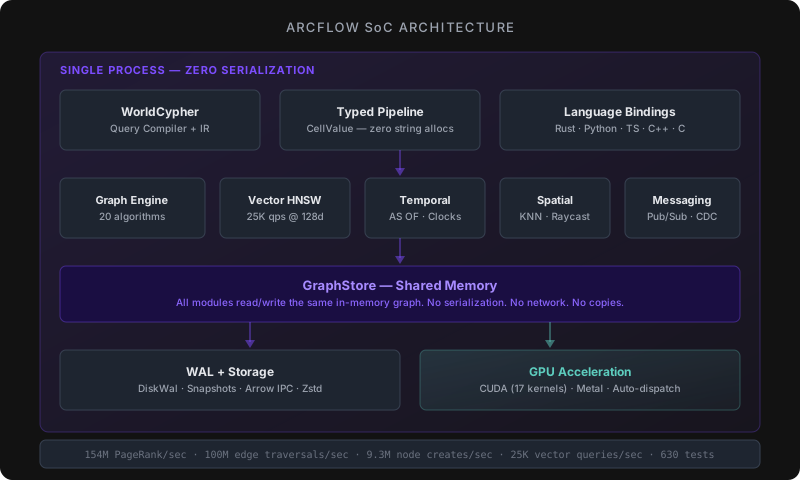
This architecture eliminates entire categories of infrastructure: no external cache service (the graph is already in-process), no separate vector database (vector indexes live alongside graph data), no workflow engine for orchestration (procedures run in the same runtime). The result is fewer moving parts, lower latency, and a single binary to deploy.
Design Principles#
- Deterministic: Same query + same state = same results. Always.
- Local-first: Single binary, full authority, no network dependency.
- Agent-native: Structured output, typed errors, machine-readable contracts.
- Rust-native: Zero-cost abstractions, memory safety, single binary.
- Zero serialization: Modules communicate through shared Rust types, not wire protocols.
- Evidence-first: Every fact carries the ArcFlow Evidence Model — observation class, confidence score, provenance chain. Trust is a query dimension, not an afterthought.
Three-Plane Architecture#
| Plane | Authority | What lives here |
|---|---|---|
| Authored Workspace | Source of truth for intent | Schemas, queries, facts in git |
| Canonical Engine | Engine-managed durability | WAL, checkpoint, manifest |
| Derived Projection | Non-authoritative | Exports, caches, compatibility files |
Rules: Workspace → Engine (explicit load). Engine → Projection (explicit export). Projections never feed back as authority.
Module architecture#
Core (bottom of stack):
| Layer | Responsibility |
|---|---|
| Core types | Node, relationship, property primitives; confidence and evidence types |
| Graph engine | Graph store, property index, adjacency structures, incremental computation, standing queries, window operators, live algorithms |
| Storage | Journaled storage, WAL, snapshot/restore |
Query and incremental (middle):
| Layer | Responsibility |
|---|---|
| Query IR | Compiled query representation — the target for the query compiler |
| Query compiler | WorldCypher (ISO GQL) parser, query planning, incrementalization |
| Runtime | Execution engine, ArcFlow Adaptive Dispatch, GPU kernels |
Public API (top of stack):
| Surface | Responsibility |
|---|---|
| Rust SDK | Published as arcflow on crates.io |
| CLI | REPL, TCP/HTTP/PostgreSQL servers, self-update, structured output — user-facing binary: arcflow |
| FFI | C ABI for Python, TypeScript, and C++ bindings |
| MCP | Model Context Protocol server (stdio JSON-RPC) |
| WASM | Browser and edge runtime |
Dependencies flow inward. Transport/CLI depend on core, never reverse.
Why This Matters#
A typical knowledge-graph stack requires 4-6 services: a graph database, a vector store, an analytics engine, a job runner, a cache, and a message bus. Each introduces serialization overhead, operational complexity, and failure modes. ArcFlow collapses this to one process and one binary — graph storage, incremental computation, vector search, and PostgreSQL wire protocol compatibility all in the same unified address space.
For AI workloads, in-process execution means a GraphRAG query can traverse the graph, run vector similarity, execute PageRank, and score confidence — all without a single network call or data format conversion. The unified in-process architecture removes every serialization boundary between those steps.
Three execution innovations sit at the core of this performance:
- ArcFlow Graph Kernel — processes graph algorithms as a single parallel pass across all nodes, not sequential traversal
- ArcFlow Adaptive Dispatch — routes each operation to the fastest available hardware (CPU, Metal, CUDA) via a live cost model at runtime
- ArcFlow GPU Index — a pointer-free spatial index that transfers directly to GPU memory, enabling high-density spatial queries at GPU speed
Forward vision: The unified address space is the foundation for in-process AI inference, real-time sensor fusion, and perception pipelines where latency budgets are measured in microseconds, not milliseconds. Same architecture, same query language, expanded compute fabric across CPU, CUDA, and Metal.
See Also#
- Threading Model — the many-reader / one-writer-per-handle concurrency contract; ArcSwap snapshots for lock-free reads; the
HANDLE_BUSY_CONCURRENT_WRITERtyped-error guard. - World Graph Substrate (Preview) — engine-architecture preview of the substrate the World Graph layer is being built on (module structure, virtual labels, residency tiers,
oz://URIs, ARC1 format) - GPU Acceleration — unified compute across CPU, CUDA, and Metal
- Language Bindings — same architecture, every language